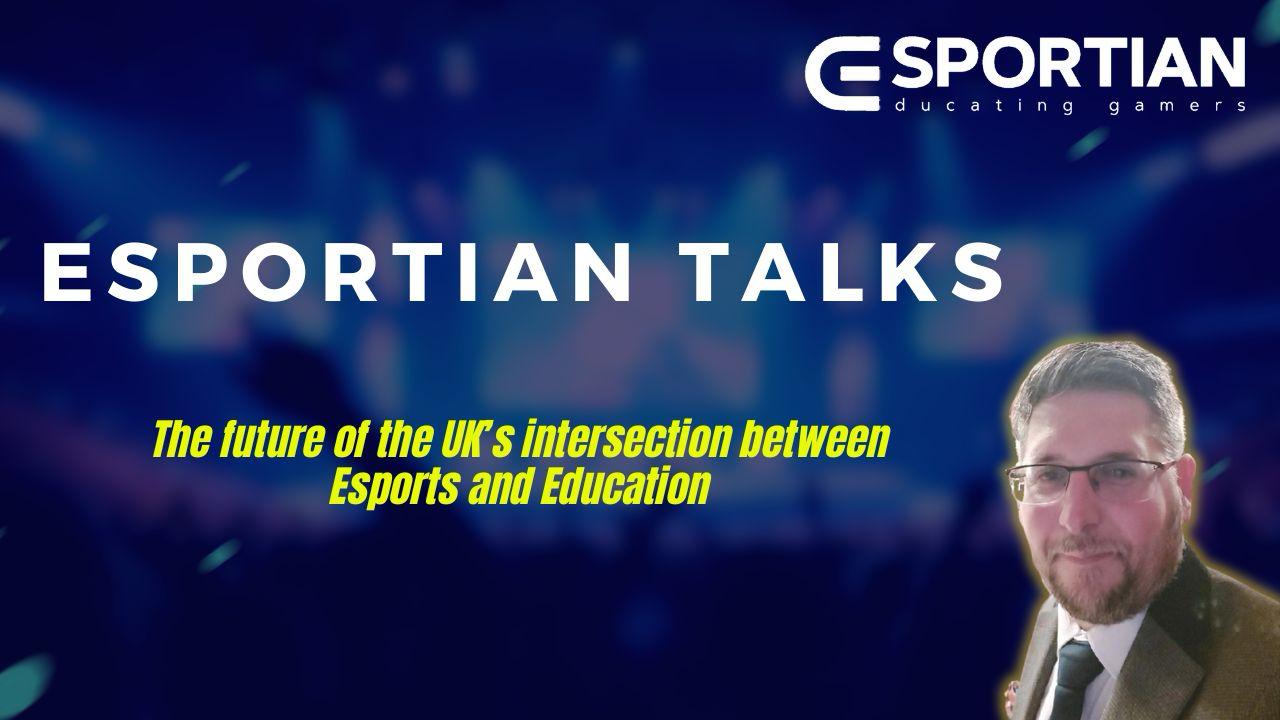
Esports education has matured quickly in the UK, the institutions that are winning are the ones building credible pathways: clear curriculum intent, measurable student outcomes, and industry-validated experience. That was the core message from my conversation with Stuart Kosters one of the most influential voices in esports education and learning technology, and now Esportian Education ’s newest Education Consultant in the UK.
Stuart’s credibility comes from designing the UK’s first university esports degree, then spending years advising institutions globally on how to translate competitive gaming culture into education that stands up to scrutiny. Today, his work extends beyond “screen-based esports” into movement-based competition and STEM innovation including the launch of the UK’s first Centre of Excellence for VR Esports Tennis at Dundee and Angus College .
How esports education actually took off in the UK
Stuart’s story highlights a pattern many leaders miss, institutional adoption begins with proof. Early on, Stuart built visibility through live events, student societies, and inter-university competition, work that made esports legible to educators and leadership. When people can see students coordinating roles, producing broadcasts, organizing brackets, and managing communities, the conversation changes. It stops being “students playing games” and becomes “students practicing employable competencies in a structured environment.”
That transition, esports as an educational vehicle helped institutions understand the opportunity: esports can unify learners from multiple disciplines (events, media, IT, business, psychology) into a single ecosystem where collaboration is not simulated, it is required.
The mistake institutions keep making
Stuart was direct about what not to do: don’t try to be everything at once. Many programs attempt to cover performance, coaching, events, production, business, wellbeing, and entrepreneurship equally, then struggle to deliver depth in any of them.
His recommendation is to build around a genuine institutional strength, your “USP” and design an esports pathway that expresses it. If you already have strong media and production provision, integrate esports broadcast and live events as the applied arena. If your strength is sport science, wellbeing, or data, design the program to prove how performance support translates into esports outcomes. The market is moving toward specialization with credibility, not generalism with branding.
The most forward-looking part of the conversation was Stuart’s work in VR esports tennis. It matters because it reframes esports education around movement, measurement, and applied learning. With VR, you can bring physical performance principles into an esports context while capturing rich performance data. That data becomes a teaching asset: biomechanics, decision-making under pressure, training design, coaching feedback loops, and analytics.
In other words, VR esports is a platform where competition and curriculum can share the same evidence base. For educators and administrators, that is the unlock: you can demonstrate learning outcomes in ways that are easier to defend to senior leadership, parents, and external stakeholders. At Dundee & Angus College, this “Centre of Excellence” concept signals where esports is heading toward labs, applied research, and interdisciplinary delivery.
What it takes to build an esports program
Stuart’s framework for building is practical, and it does not rely on large budgets or flashy facilities. It relies on discipline. First, build in stages. Programs that “run before they can walk” often overbuild on the facility side and underbuild on curriculum coherence and staffing capability. A modest, well-run program with tight industry integration will outperform a larger program that cannot prove outcomes.
Second, network relentlessly but with purpose. Stuart returned to networking repeatedly for a reason: esports is still an ecosystem where opportunity flows through relationships and delivery reputation. The strongest programs network to create work placements, guest teaching, real briefs, and hiring pipelines.
Third, design for outcomes that survive trend cycles. Games change. Platforms change. Job titles change. But core competencies persist: communication, teamwork, project delivery, production workflows, stakeholder management, and continuous improvement. If your program can evidence those outcomes through student work, the program remains valuable even as the competitive landscape shifts.
Where esports education is heading in 2026 and beyond
He expects more collaboration between education and industry, more cross-border sharing of models that work, and more institutions learning from early mistakes. He also expects the quality bar to rise. As more programs enter the space, differentiation will come from evidence: graduate outcomes, employer validation, and student work that demonstrates capability.
If there is a single thread that ties his career together from building early university esports ecosystems, to advising globally, to launching VR esports tennis innovation it is this: esports education succeeds when it is designed as education first. The games may draw students in, but the program must send them out with competence, confidence, and proof of skill.
For institutions deciding what to do next, the takeaway is simple: stop treating esports as an extracurricular branding play. Treat it as a structured learning environment, tied to outcomes, powered by industry collaboration, and built to last.
Check out the live talk:
Stuart’s credibility comes from designing the UK’s first university esports degree, then spending years advising institutions globally on how to translate competitive gaming culture into education that stands up to scrutiny. Today, his work extends beyond “screen-based esports” into movement-based competition and STEM innovation including the launch of the UK’s first Centre of Excellence for VR Esports Tennis at Dundee and Angus College .
How esports education actually took off in the UK
Stuart’s story highlights a pattern many leaders miss, institutional adoption begins with proof. Early on, Stuart built visibility through live events, student societies, and inter-university competition, work that made esports legible to educators and leadership. When people can see students coordinating roles, producing broadcasts, organizing brackets, and managing communities, the conversation changes. It stops being “students playing games” and becomes “students practicing employable competencies in a structured environment.”
That transition, esports as an educational vehicle helped institutions understand the opportunity: esports can unify learners from multiple disciplines (events, media, IT, business, psychology) into a single ecosystem where collaboration is not simulated, it is required.
The mistake institutions keep making
Stuart was direct about what not to do: don’t try to be everything at once. Many programs attempt to cover performance, coaching, events, production, business, wellbeing, and entrepreneurship equally, then struggle to deliver depth in any of them.
His recommendation is to build around a genuine institutional strength, your “USP” and design an esports pathway that expresses it. If you already have strong media and production provision, integrate esports broadcast and live events as the applied arena. If your strength is sport science, wellbeing, or data, design the program to prove how performance support translates into esports outcomes. The market is moving toward specialization with credibility, not generalism with branding.
The most forward-looking part of the conversation was Stuart’s work in VR esports tennis. It matters because it reframes esports education around movement, measurement, and applied learning. With VR, you can bring physical performance principles into an esports context while capturing rich performance data. That data becomes a teaching asset: biomechanics, decision-making under pressure, training design, coaching feedback loops, and analytics.
In other words, VR esports is a platform where competition and curriculum can share the same evidence base. For educators and administrators, that is the unlock: you can demonstrate learning outcomes in ways that are easier to defend to senior leadership, parents, and external stakeholders. At Dundee & Angus College, this “Centre of Excellence” concept signals where esports is heading toward labs, applied research, and interdisciplinary delivery.
What it takes to build an esports program
Stuart’s framework for building is practical, and it does not rely on large budgets or flashy facilities. It relies on discipline. First, build in stages. Programs that “run before they can walk” often overbuild on the facility side and underbuild on curriculum coherence and staffing capability. A modest, well-run program with tight industry integration will outperform a larger program that cannot prove outcomes.
Second, network relentlessly but with purpose. Stuart returned to networking repeatedly for a reason: esports is still an ecosystem where opportunity flows through relationships and delivery reputation. The strongest programs network to create work placements, guest teaching, real briefs, and hiring pipelines.
Third, design for outcomes that survive trend cycles. Games change. Platforms change. Job titles change. But core competencies persist: communication, teamwork, project delivery, production workflows, stakeholder management, and continuous improvement. If your program can evidence those outcomes through student work, the program remains valuable even as the competitive landscape shifts.
Where esports education is heading in 2026 and beyond
He expects more collaboration between education and industry, more cross-border sharing of models that work, and more institutions learning from early mistakes. He also expects the quality bar to rise. As more programs enter the space, differentiation will come from evidence: graduate outcomes, employer validation, and student work that demonstrates capability.
If there is a single thread that ties his career together from building early university esports ecosystems, to advising globally, to launching VR esports tennis innovation it is this: esports education succeeds when it is designed as education first. The games may draw students in, but the program must send them out with competence, confidence, and proof of skill.
For institutions deciding what to do next, the takeaway is simple: stop treating esports as an extracurricular branding play. Treat it as a structured learning environment, tied to outcomes, powered by industry collaboration, and built to last.
Check out the live talk:
