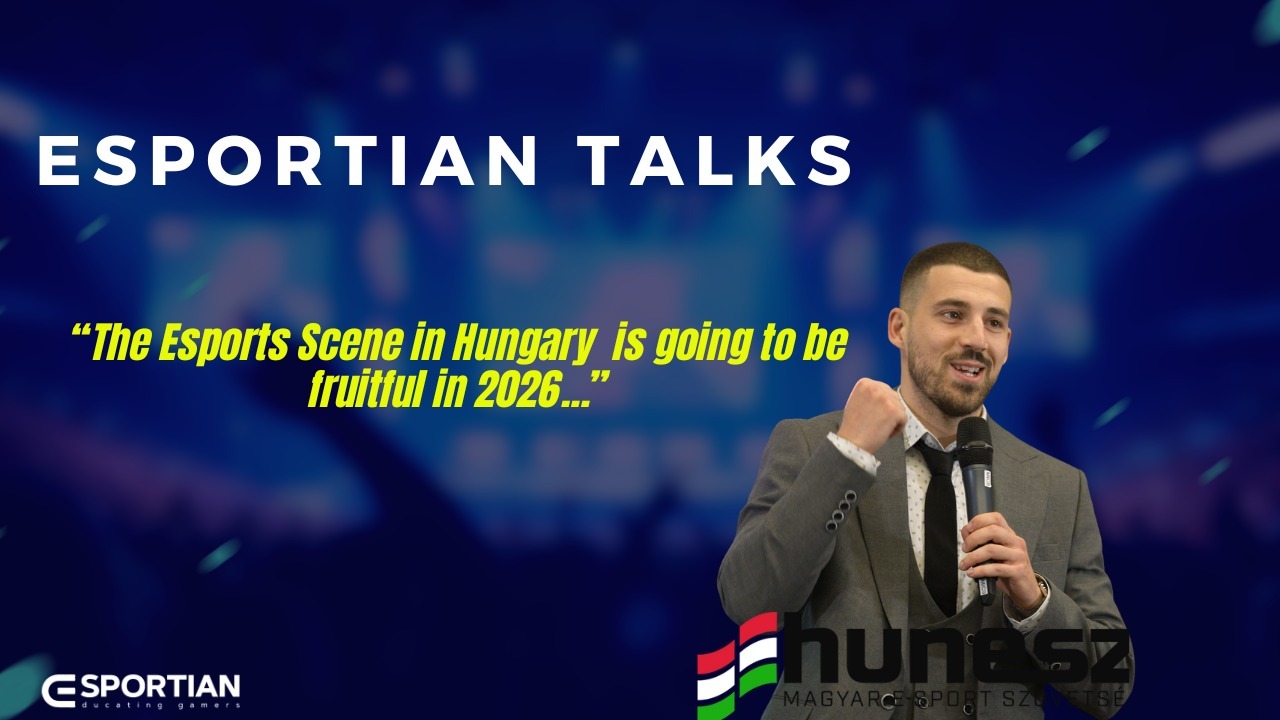
As esports continues to mature globally, questions of legitimacy, sustainability, and long-term player development are increasingly shaping the direction of the industry. In a recent interview, Oliver Szabella, PhD , Director of Esports, performance expert, International Olympic Committee – IOC Young Leaders alumnus, and Chair of the Education Committee at the Hungarian Esports Federation - HUNESZ offered a perspective on how education systems, national federations, and performance science must converge to support the next phase of esports growth.
Oliver’s trajectory reflects this convergence. With formal academic training in sports science and a doctoral focus on esports performance, combined with firsthand experience as a former competitive player, his work operates at the intersection of governance, education, and applied performance. His current roles within HUNESZ and at Óbuda University position him to influence esports development across grassroots, academic, and institutional pathways.
A central theme of the discussion was the evolving role of national federations. Szabella emphasized that federations must extend beyond organizing competitions and instead provide structural clarity for players, parents, educators, and institutions. In Hungary, this has required moving away from what he described as a “wild west” ecosystem toward a transparent, strategy-driven framework that clearly outlines how individuals can engage with esports at different stages of their development. For younger players, this means understanding what opportunities exist, which organizations to approach, and how esports can align with education rather than compete with it.
Education plays a key role in this vision. At Óbuda University, Szabella has helped design a multi-layered esports strategy built on three pillars: curriculum, research, and competition. The academic component includes structured programs in esports coaching, leadership, and event organization, offered both as accessible short courses and as post-graduate university certifications. This dual-track model reflects a broader goal of professionalizing esports roles while ensuring accessibility for individuals at different stages of their careers.
Equally important is research. Szabella argued that for esports to be taken seriously within higher education and public institutions, it must be supported by rigorous, peer-reviewed research. Universities provide the necessary infrastructure for producing credible data on performance, health, cognition, and learning outcomes. In countries where esports research is still emerging, this academic foundation is critical not only for international credibility but also for evidence-based policymaking at the federation level.
Performance science remains at the core of Szabella’s work. Drawing from his doctoral research, he highlighted a persistent misconception within esports: that optimal performance is achieved solely through increased in-game practice. His findings demonstrate the opposite. By integrating physical activity into training routines, players were able to maintain or even improve cognitive and mechanical performance after prolonged gaming sessions. These results provide empirical support for adopting principles long established in traditional sports, including physical conditioning, recovery, sleep hygiene, and nutrition.
He noted that this integration is especially important at the developmental level. Younger players are often resistant to non-gaming activities, perceiving them as distractions from improvement. However, when presented with objective performance data, many become more receptive to physical training as a performance-enhancing tool rather than a lifestyle recommendation. This evidence-based approach, he argued, is essential for improving player longevity and well-being in an industry where burnout remains prevalent.
Looking ahead to 2026, OIliver’s objectives are firmly rooted in strategic frameworks now in place at both the federation and university levels, the next phase focuses on scaling, institutional partnerships, and expanding outreach into secondary education. His long-term vision is one in which esports is fully embedded within existing educational systems, recognized not as a novelty, but as a legitimate domain requiring the same governance, support structures, and ethical considerations as traditional sport.
Ultimately, Dr. Szabella framed the future of esports and education as inseparable. Sustainable growth, he argued, depends on acceptance within formal education, evidence-based performance practices, and coordinated governance. Without these elements, esports risks remaining fragmented and short-term in its impact. With them, it has the potential to become a durable, inclusive pathway for competitive, academic development, and lifelong skill acquisition.
Oliver’s trajectory reflects this convergence. With formal academic training in sports science and a doctoral focus on esports performance, combined with firsthand experience as a former competitive player, his work operates at the intersection of governance, education, and applied performance. His current roles within HUNESZ and at Óbuda University position him to influence esports development across grassroots, academic, and institutional pathways.
A central theme of the discussion was the evolving role of national federations. Szabella emphasized that federations must extend beyond organizing competitions and instead provide structural clarity for players, parents, educators, and institutions. In Hungary, this has required moving away from what he described as a “wild west” ecosystem toward a transparent, strategy-driven framework that clearly outlines how individuals can engage with esports at different stages of their development. For younger players, this means understanding what opportunities exist, which organizations to approach, and how esports can align with education rather than compete with it.
Education plays a key role in this vision. At Óbuda University, Szabella has helped design a multi-layered esports strategy built on three pillars: curriculum, research, and competition. The academic component includes structured programs in esports coaching, leadership, and event organization, offered both as accessible short courses and as post-graduate university certifications. This dual-track model reflects a broader goal of professionalizing esports roles while ensuring accessibility for individuals at different stages of their careers.
Equally important is research. Szabella argued that for esports to be taken seriously within higher education and public institutions, it must be supported by rigorous, peer-reviewed research. Universities provide the necessary infrastructure for producing credible data on performance, health, cognition, and learning outcomes. In countries where esports research is still emerging, this academic foundation is critical not only for international credibility but also for evidence-based policymaking at the federation level.
Performance science remains at the core of Szabella’s work. Drawing from his doctoral research, he highlighted a persistent misconception within esports: that optimal performance is achieved solely through increased in-game practice. His findings demonstrate the opposite. By integrating physical activity into training routines, players were able to maintain or even improve cognitive and mechanical performance after prolonged gaming sessions. These results provide empirical support for adopting principles long established in traditional sports, including physical conditioning, recovery, sleep hygiene, and nutrition.
He noted that this integration is especially important at the developmental level. Younger players are often resistant to non-gaming activities, perceiving them as distractions from improvement. However, when presented with objective performance data, many become more receptive to physical training as a performance-enhancing tool rather than a lifestyle recommendation. This evidence-based approach, he argued, is essential for improving player longevity and well-being in an industry where burnout remains prevalent.
Looking ahead to 2026, OIliver’s objectives are firmly rooted in strategic frameworks now in place at both the federation and university levels, the next phase focuses on scaling, institutional partnerships, and expanding outreach into secondary education. His long-term vision is one in which esports is fully embedded within existing educational systems, recognized not as a novelty, but as a legitimate domain requiring the same governance, support structures, and ethical considerations as traditional sport.
Ultimately, Dr. Szabella framed the future of esports and education as inseparable. Sustainable growth, he argued, depends on acceptance within formal education, evidence-based performance practices, and coordinated governance. Without these elements, esports risks remaining fragmented and short-term in its impact. With them, it has the potential to become a durable, inclusive pathway for competitive, academic development, and lifelong skill acquisition.
