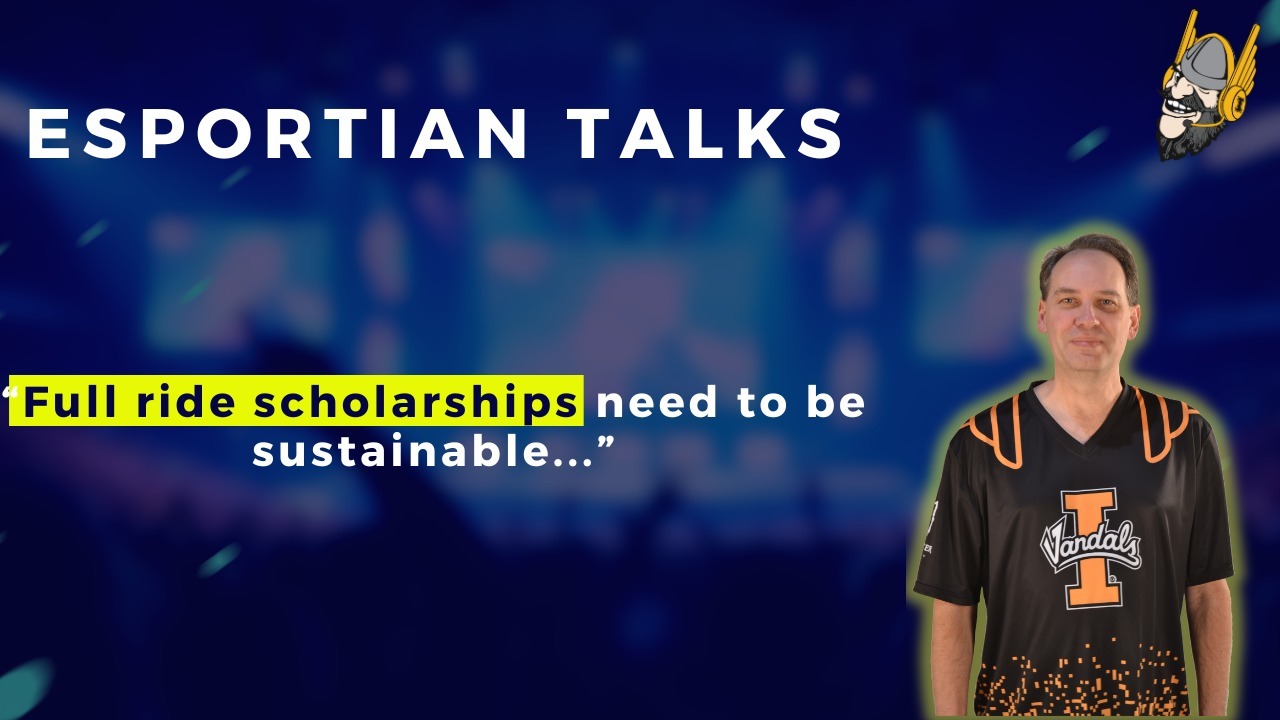
As collegiate esports starts its second decade, a critical question has emerged: what makes a program sustainable? Beyond the excitement of new arenas, scholarships, and national competitions, sustainability demands a deeper look at financial models, academic alignment, and institutional integration. To explore this question, I sat down with Wayne Ebenroth , Esports Director at the University of Idaho .
Ebenroth’s philosophy diverges from the “win-now” mentality that characterizes much of collegiate esports. For him, sustainability begins with rethinking the purpose of an esports program as a framework for student development, community engagement, and institutional value creation.
In many collegiate programs, recruiting is the central narrative. Universities compete to attract top-tier players, often framing esports as a fast track to championships and visibility. Wayne warns that this approach, while understandable, often prioritizes short-term prestige over long-term viability. Recruiting without regard for a four-year plan, academic progression, affordability, and student well-being does a disservice to students.
He shared a striking example: two students from Idaho who had accepted esports scholarships at out-of-state private universities. Each received approximately $3,000 in aid, an enticing number for high school students seeking validation for their years of gaming. Yet, these scholarships barely made a dent in their overall costs. With annual tuition amounting around $40,000, both students quickly exhausted their financial aid limits and dropped out within a semester. By the end, one owed $17,000 in debt, the other $14,000.
For Ebenroth, this illustrates the need for transparency and realism in recruitment. Esports scholarships, while exciting, must make financial sense within the broader context of a student’s education. Programs that chase recruitment metrics without helping students map their academic and financial journeys risk doing more harm than good. Sustainability, he argues, begins with responsible admissions practices that view players as students first and competitors second.
Wayne is clear about the economics of collegiate esports: full-ride scholarships are exceedingly rare, especially at public institutions. Unlike athletic programs that have decades of endowments, alumni donors, and television contracts behind them, collegiate esports remains largely self-funded and experimental. As a result, most scholarships function as modest incentives rather than comprehensive financial packages.
This reality creates a tension between perception and practice. Students often hear “scholarship” and imagine a financial solution to college expenses. In practice, esports scholarships rarely offset more than a fraction of total tuition and fees. Ebenroth emphasizes that this gap requires clear communication, not to dissuade students from pursuing esports, but to help them understand the full picture. If esports programs are to be sustainable, he argues, they must redefine scholarships not as recruitment tools but as mechanisms for academic support, completion, and professional growth.
What sets the University of Idaho apart is where its esports program resides: under the Division of Student Affairs rather than Athletics. Under Student Affairs, the program’s primary mandate is engagement. Ebenroth’s job is not only to manage teams, but to create pathways for as many students as possible to find belonging through gaming. The program’s 2,100-square-foot facility houses 31 gaming PCs and a range of consoles, operating at full capacity since opening. Students come not just to compete, but to collaborate, learn, and build practical experience in media production, event management, and digital communication.
An especially innovative component of Idaho’s model is its integration of the federal work-study program. The university employs roughly 30 students each semester across social media, broadcasting, analytics, and operations roles. This system provides students with hands-on professional experience while offsetting labor costs through federal aid, a structure Ebenroth describes as a “win-win” for both education and sustainability.
Equally important is how the program engages faculty and administrators. The University of Idaho frequently invites professors, deans, and senior staff to appear on broadcasts, participate in pre-game interviews, or even play in casual matches. This deliberate exposure creates understanding and advocacy across campus.
One of the key points of Wayne’s approach is his insistence on redefining success. Wins and losses matter, but they are not the only or even primary indicators of a healthy program. Instead, UI measures impact through multiple dimensions: engagement, academic progress, and institutional presence.
In 2024, the university recorded more than 10,000 lab visits, evidence of the program’s reach beyond varsity rosters. Over 100 student-athletes competed across various titles, while dozens more participated in supporting roles in broadcasting, marketing, and analysis. Academic metrics are tracked as rigorously as competitive ones. Idaho has implemented an academic support system modeled on athletics, requiring students with lower GPAs to attend check-ins, review assignments, and access tutoring. The early data are promising students in esports show higher-than-average GPAs compared to their peers, a finding consistent with broader trends across collegiate gaming.
Esports programs operate in a resource-constrained environment, and the temptation to overextend is constant. Idaho’s funding structure combines institutional support from Student Affairs, federal work-study, and a modest but growing portfolio of local sponsorships. The university’s president provided an initial seed fund of $50,000, followed by an annual budget allocation that now exceeds $180,000. Additional revenue comes from creative initiatives, students work concessions at athletic events, host local tournaments, and secure small product sponsorships with companies like Monster Energy and regional internet providers.
Wayne is transparent about the challenges of maintaining this balance. His workload, particularly in the program’s early years, bordered on unsustainable. Days often stretch late into the night, with administrative meetings in the morning and scrimmages or broadcasts in the evening. “I survive because I love what I do,” he admits. “But this is not a job you do alone forever. Sustainability means delegation, structure, and trust in your team.”
By leveraging the work-study system and training student managers, UI is creating an operational model that distributes responsibility across a network of emerging professionals. This not only mitigates burnout but mirrors the collaborative nature of esports itself, a coordinated system where success depends on the whole team.
When asked to define sustainability, Ebenroth pauses. For him, it is not merely about financial survival or competitive endurance. Sustainability is about institutionalization, embedding esports deeply enough within the fabric of the university that it becomes indispensable. That means aligning with multiple academic departments, securing administrative stakeholders, and ensuring that students graduate as players and skilled professionals ready to contribute to the digital economy.
True sustainability, in his view, has two components. The first is financial stability, ideally through diversified funding and long-term commitments from the university. The second, and more critical, is cultural buy-in. Programs endure when faculty see value, when administrators understand the outcomes, and when students view esports as part of their educational identity rather than a side activity. “If you want your program to last,” Ebenroth says, “you need to make sure everyone feels they have a stake in it.”
Looking ahead, Wayne envisions esports as an academic discipline. His team has begun developing a proposal for a Bachelor’s degree in Esports, integrating the Journalism and Mass Media Department with the College of Business. The program would feature two main tracks: one focused on production and broadcasting, and another centered on management, marketing, and entrepreneurship.
This academic expansion is part of a broader strategy to anchor esports in the university’s educational mission. For Idaho, this represents the next step in sustainability: transforming esports into an academic pathway with measurable outcomes.
In the closing moments of our conversation, Ebenroth reflected on the broader trajectory of collegiate esports. A century ago, football was considered a novelty, an extracurricular experiment with uncertain academic value. Today, it is an institutional cornerstone. Esports, he argues, occupies a similar moment in its evolution. “If you told someone in 1920 that college football would one day define entire universities, they would’ve laughed. But look where we are. Esports is the next frontier, it’s more inclusive, more accessible, and it speaks the language of this generation.”
For the University of Idaho, sustainability is about building deliberately, balancing ambition with responsibility, and enthusiasm with structure. The lesson from Ebenroth’s work is clear: collegiate esports will thrive not because of who wins the next championship, but because of who builds the systems that make winning possible year after year.
Ebenroth’s philosophy diverges from the “win-now” mentality that characterizes much of collegiate esports. For him, sustainability begins with rethinking the purpose of an esports program as a framework for student development, community engagement, and institutional value creation.
In many collegiate programs, recruiting is the central narrative. Universities compete to attract top-tier players, often framing esports as a fast track to championships and visibility. Wayne warns that this approach, while understandable, often prioritizes short-term prestige over long-term viability. Recruiting without regard for a four-year plan, academic progression, affordability, and student well-being does a disservice to students.
He shared a striking example: two students from Idaho who had accepted esports scholarships at out-of-state private universities. Each received approximately $3,000 in aid, an enticing number for high school students seeking validation for their years of gaming. Yet, these scholarships barely made a dent in their overall costs. With annual tuition amounting around $40,000, both students quickly exhausted their financial aid limits and dropped out within a semester. By the end, one owed $17,000 in debt, the other $14,000.
For Ebenroth, this illustrates the need for transparency and realism in recruitment. Esports scholarships, while exciting, must make financial sense within the broader context of a student’s education. Programs that chase recruitment metrics without helping students map their academic and financial journeys risk doing more harm than good. Sustainability, he argues, begins with responsible admissions practices that view players as students first and competitors second.
Wayne is clear about the economics of collegiate esports: full-ride scholarships are exceedingly rare, especially at public institutions. Unlike athletic programs that have decades of endowments, alumni donors, and television contracts behind them, collegiate esports remains largely self-funded and experimental. As a result, most scholarships function as modest incentives rather than comprehensive financial packages.
This reality creates a tension between perception and practice. Students often hear “scholarship” and imagine a financial solution to college expenses. In practice, esports scholarships rarely offset more than a fraction of total tuition and fees. Ebenroth emphasizes that this gap requires clear communication, not to dissuade students from pursuing esports, but to help them understand the full picture. If esports programs are to be sustainable, he argues, they must redefine scholarships not as recruitment tools but as mechanisms for academic support, completion, and professional growth.
What sets the University of Idaho apart is where its esports program resides: under the Division of Student Affairs rather than Athletics. Under Student Affairs, the program’s primary mandate is engagement. Ebenroth’s job is not only to manage teams, but to create pathways for as many students as possible to find belonging through gaming. The program’s 2,100-square-foot facility houses 31 gaming PCs and a range of consoles, operating at full capacity since opening. Students come not just to compete, but to collaborate, learn, and build practical experience in media production, event management, and digital communication.
An especially innovative component of Idaho’s model is its integration of the federal work-study program. The university employs roughly 30 students each semester across social media, broadcasting, analytics, and operations roles. This system provides students with hands-on professional experience while offsetting labor costs through federal aid, a structure Ebenroth describes as a “win-win” for both education and sustainability.
Equally important is how the program engages faculty and administrators. The University of Idaho frequently invites professors, deans, and senior staff to appear on broadcasts, participate in pre-game interviews, or even play in casual matches. This deliberate exposure creates understanding and advocacy across campus.
One of the key points of Wayne’s approach is his insistence on redefining success. Wins and losses matter, but they are not the only or even primary indicators of a healthy program. Instead, UI measures impact through multiple dimensions: engagement, academic progress, and institutional presence.
In 2024, the university recorded more than 10,000 lab visits, evidence of the program’s reach beyond varsity rosters. Over 100 student-athletes competed across various titles, while dozens more participated in supporting roles in broadcasting, marketing, and analysis. Academic metrics are tracked as rigorously as competitive ones. Idaho has implemented an academic support system modeled on athletics, requiring students with lower GPAs to attend check-ins, review assignments, and access tutoring. The early data are promising students in esports show higher-than-average GPAs compared to their peers, a finding consistent with broader trends across collegiate gaming.
Esports programs operate in a resource-constrained environment, and the temptation to overextend is constant. Idaho’s funding structure combines institutional support from Student Affairs, federal work-study, and a modest but growing portfolio of local sponsorships. The university’s president provided an initial seed fund of $50,000, followed by an annual budget allocation that now exceeds $180,000. Additional revenue comes from creative initiatives, students work concessions at athletic events, host local tournaments, and secure small product sponsorships with companies like Monster Energy and regional internet providers.
Wayne is transparent about the challenges of maintaining this balance. His workload, particularly in the program’s early years, bordered on unsustainable. Days often stretch late into the night, with administrative meetings in the morning and scrimmages or broadcasts in the evening. “I survive because I love what I do,” he admits. “But this is not a job you do alone forever. Sustainability means delegation, structure, and trust in your team.”
By leveraging the work-study system and training student managers, UI is creating an operational model that distributes responsibility across a network of emerging professionals. This not only mitigates burnout but mirrors the collaborative nature of esports itself, a coordinated system where success depends on the whole team.
When asked to define sustainability, Ebenroth pauses. For him, it is not merely about financial survival or competitive endurance. Sustainability is about institutionalization, embedding esports deeply enough within the fabric of the university that it becomes indispensable. That means aligning with multiple academic departments, securing administrative stakeholders, and ensuring that students graduate as players and skilled professionals ready to contribute to the digital economy.
True sustainability, in his view, has two components. The first is financial stability, ideally through diversified funding and long-term commitments from the university. The second, and more critical, is cultural buy-in. Programs endure when faculty see value, when administrators understand the outcomes, and when students view esports as part of their educational identity rather than a side activity. “If you want your program to last,” Ebenroth says, “you need to make sure everyone feels they have a stake in it.”
Looking ahead, Wayne envisions esports as an academic discipline. His team has begun developing a proposal for a Bachelor’s degree in Esports, integrating the Journalism and Mass Media Department with the College of Business. The program would feature two main tracks: one focused on production and broadcasting, and another centered on management, marketing, and entrepreneurship.
This academic expansion is part of a broader strategy to anchor esports in the university’s educational mission. For Idaho, this represents the next step in sustainability: transforming esports into an academic pathway with measurable outcomes.
In the closing moments of our conversation, Ebenroth reflected on the broader trajectory of collegiate esports. A century ago, football was considered a novelty, an extracurricular experiment with uncertain academic value. Today, it is an institutional cornerstone. Esports, he argues, occupies a similar moment in its evolution. “If you told someone in 1920 that college football would one day define entire universities, they would’ve laughed. But look where we are. Esports is the next frontier, it’s more inclusive, more accessible, and it speaks the language of this generation.”
For the University of Idaho, sustainability is about building deliberately, balancing ambition with responsibility, and enthusiasm with structure. The lesson from Ebenroth’s work is clear: collegiate esports will thrive not because of who wins the next championship, but because of who builds the systems that make winning possible year after year.
