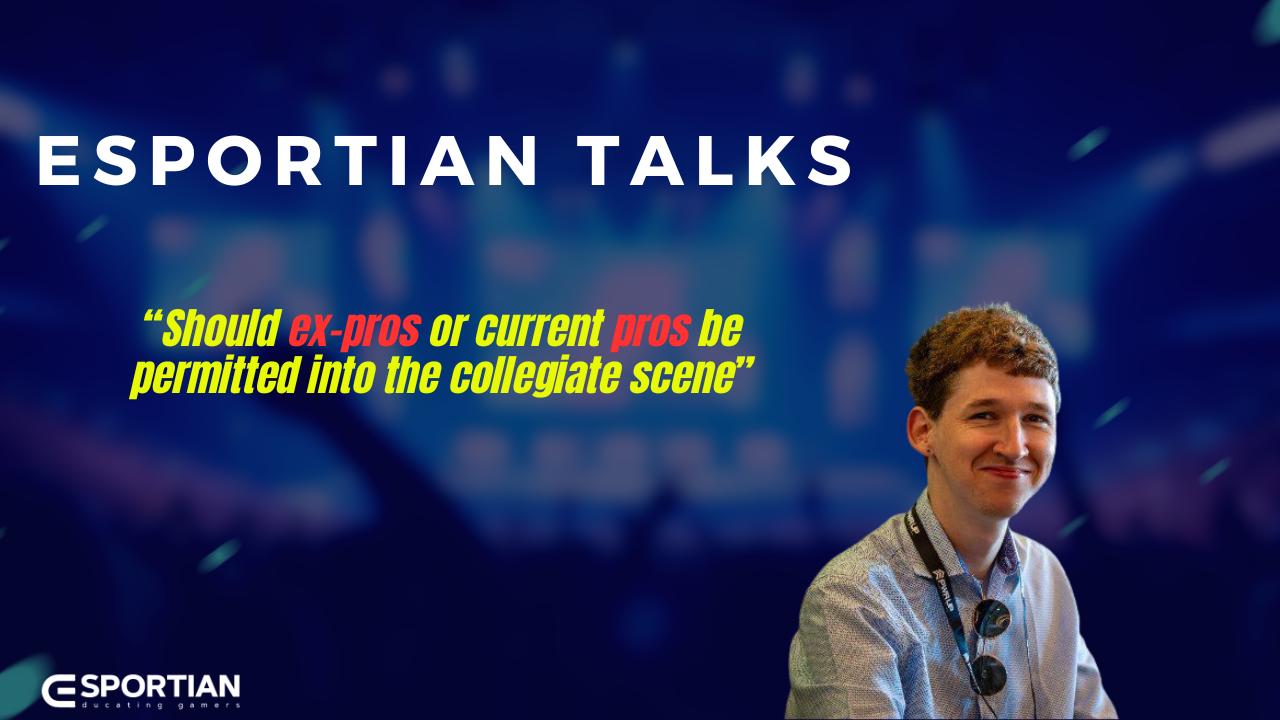
As Board Parliamentarian at the National Esports Collegiate Conference , a writer covering the space through College Esports News , a former social media manager for College Esports, and a current marketing director by profession, he understands the ecosystem simultaneously as a governance problem, a communications problem, and an operational reality. In our conversation, we used that multi-angle perspective to address one of the most persistent and polarizing questions in the scene: should professional players be permitted to compete in collegiate esports?
At the center of the debate is a tension between access and competitive integrity. On one side, critics argue that allowing pros undermines fairness for “true” student competitors and can distort the educational purpose of programs. On the other hand, advocates argue that collegiate esports should remain open to any enrolled student, regardless of prior competitive status, particularly because esports does not resemble traditional sport pathways. Alex Niall does not adopt either extreme. Instead, he frames the issue as a systems-design challenge: the question is not whether people should be excluded, but whether leagues are sufficiently structured to ensure that participants compete at appropriate levels and that the outcomes remain meaningful for students and institutions alike.
A key contribution of Alex’s perspective is his insistence that leagues, not individual programs ultimately shape the competitive experience. He points to the NECC’s broad participation model and multi-division structure as a practical solution to the “pros vs. students” conflict. In Rocket League, for example, the performance gap between a high-ranked collegiate player and a tier-one professional categorical. Alex describes himself as a strong player relative to the overall player base, yet still incapable of producing a competitive match against professionals. That observation matters because it clarifies the real problem: mixing skills inside the same competitive bracket does not create “hard competition,” it produces predictable outcomes and weakens the developmental, motivational, and entertainment value of the league for everyone involved. In Alex’s view, divisional segmentation based on competitive level reduces incentives for exclusionary eligibility rules while protecting match quality and student experience.
This emphasis on league structure also reframes common complaints about “unfair” matchups. When a collegiate system places professional or semi-professional talent into a top division where peers share similar ability, the integrity issue becomes less about eligibility and more about classification accuracy. Conversely, when rosters are altered mid-competition, particularly at national events the perceived unfairness is less about a player’s “pro” label and more about governance failures around roster locks, transfers, and competitive continuity. A viewer’s frustration in such cases is intuitive: collegiate leagues rely on season-long performance for competitive legitimacy, and late changes can invalidate the stats and qualification pathways. Alex treats these instances as evidence that roster policy, not simply player background, is becoming a central integrity risk in collegiate esports.
The conversation then turns to a structural constraint that makes collegiate esports uniquely difficult to regulate: fragmentation. Unlike traditional intercollegiate sports with one dominant governing body, esports features multiple major leagues and a long tail of regional organizers, each with different incentives. Alex expresses cautious support for eventual rule standardization, but he is realistic about the politics of competition among leagues. Even when alignment would benefit the ecosystem, individual leagues have rational incentives to differentiate their policies to attract more teams, retain market share, or lower participation friction. The result is a landscape where “eligibility” is not a single concept but a set of league-specific regimes that programs must navigate strategically.
This fragmentation becomes especially visible in transfer policy. Alex notes that collegiate esports seasons are often split across fall and spring, which complicates direct comparisons to the continuous competitive calendars of many NCAA sports. From a purely logistical standpoint, it becomes difficult to justify restrictions on transferring between semesters. Yet the program-level implications are significant. Rosters are marketing assets, retention mechanisms, and, for some institutions, pillars of recruitment strategy. When key players depart abruptly, programs face disruption in performance and identity, and the broader ecosystem absorbs instability. Alex suggests that the community has not yet fully reconciled player autonomy with program sustainability, and that public discourse often misses critical context because contractual terms, academic motivations, and institutional constraints are usually private.
Scholarships add another layer of complexity because they shape incentives for both players and schools. Alex is skeptical that prize pools meaningfully drive most participation decisions, noting that in some environments winnings may not flow directly to students and that the overwhelming majority of collegiate players will never be in a position to compete for prize money. Instead, he argues that academic opportunity and affordability are the primary drivers of rational decision-making, especially as professional esports becomes more volatile and as players age out of peak performance windows. In that context, collegiate esports can function as a transition mechanism: a way for high-level competitors to secure an education while leveraging skill to offset costs. The sustainability question, however, hinges on how scholarships are deployed. If programs treat scholarships as a short-term purchase of wins, the model can become financially fragile and institutionally vulnerable. If scholarships support a broader retention and student-success strategy, one that produces satisfied graduates and positive alumni outcomes, then competitive spending can be defensible as part of a larger enrollment and engagement framework.
The discussion also surfaced a related controversy: online degree pathways and their implications for competitive participation. Alex does not reject online students as ineligible on principle. Instead, he raises a more academically grounded concern: the risk that “online” becomes a proxy for reduced academic rigor or weaker educational integration, particularly if esports participation is treated as the main value proposition. His position is that the core eligibility question should be academic progress rather than modality. If collegiate esports exists to support educational attainment, then leagues and institutions should prioritize standards that verify real progression toward graduation, regardless of whether a student is on campus.
Where Alex becomes most direct is on compliance and enforcement. He argues that collegiate esports is still maturing into a credible competitive domain, and that integrity threats extend well beyond debates about pros. Cheating, identity issues, and other forms of rule circumvention, especially in online play, pose persistent challenges. His view is unsentimental: enforcement will always lag innovation in cheating methods, and even in-person environments do not guarantee integrity without robust oversight. From a governance standpoint, this implies that the long-term legitimacy of collegiate esports depends less on categorical eligibility bans and more on transparent policy, enforceable roster rules, proportionate compliance mechanisms, and cultural norms that align competitive ambition with educational responsibility.
Taken together, Alex’s position is best understood as an argument for institutional design over moral classification. He does not claim that pro participation is inherently fair or unfair. He argues that fairness is produced or eroded by structures: divisional systems that place comparable skill in the same bracket, roster policies that preserve competitive continuity, academic standards that prevent “esports-first” enrollment, and compliance mechanisms that acknowledge the realities of online competition. His most consequential assertion is also the simplest: collegiate esports should be evaluated by whether it moves students from entry to graduation with stronger skills, stronger networks, and better opportunities. When programs treat esports as a tool for education rather than a substitute for it, the ecosystem becomes more sustainable, and more credible regardless of whether the roster includes former professionals.
If collegiate esports is to evolve responsibly, the debate over professional eligibility should be treated as one component of a larger governance agenda. Eligibility rules matter, but they are not a substitute for coherent divisions, stable transfer policies, enforceable integrity standards, and evidence-based accountability around student outcomes. Alex’s multi-angle perspective highlights the practical path forward: reduce mismatch, reduce ambiguity, and design leagues that can accommodate diverse competitive backgrounds without compromising the fundamental promise of collegiate participation.
At the center of the debate is a tension between access and competitive integrity. On one side, critics argue that allowing pros undermines fairness for “true” student competitors and can distort the educational purpose of programs. On the other hand, advocates argue that collegiate esports should remain open to any enrolled student, regardless of prior competitive status, particularly because esports does not resemble traditional sport pathways. Alex Niall does not adopt either extreme. Instead, he frames the issue as a systems-design challenge: the question is not whether people should be excluded, but whether leagues are sufficiently structured to ensure that participants compete at appropriate levels and that the outcomes remain meaningful for students and institutions alike.
A key contribution of Alex’s perspective is his insistence that leagues, not individual programs ultimately shape the competitive experience. He points to the NECC’s broad participation model and multi-division structure as a practical solution to the “pros vs. students” conflict. In Rocket League, for example, the performance gap between a high-ranked collegiate player and a tier-one professional categorical. Alex describes himself as a strong player relative to the overall player base, yet still incapable of producing a competitive match against professionals. That observation matters because it clarifies the real problem: mixing skills inside the same competitive bracket does not create “hard competition,” it produces predictable outcomes and weakens the developmental, motivational, and entertainment value of the league for everyone involved. In Alex’s view, divisional segmentation based on competitive level reduces incentives for exclusionary eligibility rules while protecting match quality and student experience.
This emphasis on league structure also reframes common complaints about “unfair” matchups. When a collegiate system places professional or semi-professional talent into a top division where peers share similar ability, the integrity issue becomes less about eligibility and more about classification accuracy. Conversely, when rosters are altered mid-competition, particularly at national events the perceived unfairness is less about a player’s “pro” label and more about governance failures around roster locks, transfers, and competitive continuity. A viewer’s frustration in such cases is intuitive: collegiate leagues rely on season-long performance for competitive legitimacy, and late changes can invalidate the stats and qualification pathways. Alex treats these instances as evidence that roster policy, not simply player background, is becoming a central integrity risk in collegiate esports.
The conversation then turns to a structural constraint that makes collegiate esports uniquely difficult to regulate: fragmentation. Unlike traditional intercollegiate sports with one dominant governing body, esports features multiple major leagues and a long tail of regional organizers, each with different incentives. Alex expresses cautious support for eventual rule standardization, but he is realistic about the politics of competition among leagues. Even when alignment would benefit the ecosystem, individual leagues have rational incentives to differentiate their policies to attract more teams, retain market share, or lower participation friction. The result is a landscape where “eligibility” is not a single concept but a set of league-specific regimes that programs must navigate strategically.
This fragmentation becomes especially visible in transfer policy. Alex notes that collegiate esports seasons are often split across fall and spring, which complicates direct comparisons to the continuous competitive calendars of many NCAA sports. From a purely logistical standpoint, it becomes difficult to justify restrictions on transferring between semesters. Yet the program-level implications are significant. Rosters are marketing assets, retention mechanisms, and, for some institutions, pillars of recruitment strategy. When key players depart abruptly, programs face disruption in performance and identity, and the broader ecosystem absorbs instability. Alex suggests that the community has not yet fully reconciled player autonomy with program sustainability, and that public discourse often misses critical context because contractual terms, academic motivations, and institutional constraints are usually private.
Scholarships add another layer of complexity because they shape incentives for both players and schools. Alex is skeptical that prize pools meaningfully drive most participation decisions, noting that in some environments winnings may not flow directly to students and that the overwhelming majority of collegiate players will never be in a position to compete for prize money. Instead, he argues that academic opportunity and affordability are the primary drivers of rational decision-making, especially as professional esports becomes more volatile and as players age out of peak performance windows. In that context, collegiate esports can function as a transition mechanism: a way for high-level competitors to secure an education while leveraging skill to offset costs. The sustainability question, however, hinges on how scholarships are deployed. If programs treat scholarships as a short-term purchase of wins, the model can become financially fragile and institutionally vulnerable. If scholarships support a broader retention and student-success strategy, one that produces satisfied graduates and positive alumni outcomes, then competitive spending can be defensible as part of a larger enrollment and engagement framework.
The discussion also surfaced a related controversy: online degree pathways and their implications for competitive participation. Alex does not reject online students as ineligible on principle. Instead, he raises a more academically grounded concern: the risk that “online” becomes a proxy for reduced academic rigor or weaker educational integration, particularly if esports participation is treated as the main value proposition. His position is that the core eligibility question should be academic progress rather than modality. If collegiate esports exists to support educational attainment, then leagues and institutions should prioritize standards that verify real progression toward graduation, regardless of whether a student is on campus.
Where Alex becomes most direct is on compliance and enforcement. He argues that collegiate esports is still maturing into a credible competitive domain, and that integrity threats extend well beyond debates about pros. Cheating, identity issues, and other forms of rule circumvention, especially in online play, pose persistent challenges. His view is unsentimental: enforcement will always lag innovation in cheating methods, and even in-person environments do not guarantee integrity without robust oversight. From a governance standpoint, this implies that the long-term legitimacy of collegiate esports depends less on categorical eligibility bans and more on transparent policy, enforceable roster rules, proportionate compliance mechanisms, and cultural norms that align competitive ambition with educational responsibility.
Taken together, Alex’s position is best understood as an argument for institutional design over moral classification. He does not claim that pro participation is inherently fair or unfair. He argues that fairness is produced or eroded by structures: divisional systems that place comparable skill in the same bracket, roster policies that preserve competitive continuity, academic standards that prevent “esports-first” enrollment, and compliance mechanisms that acknowledge the realities of online competition. His most consequential assertion is also the simplest: collegiate esports should be evaluated by whether it moves students from entry to graduation with stronger skills, stronger networks, and better opportunities. When programs treat esports as a tool for education rather than a substitute for it, the ecosystem becomes more sustainable, and more credible regardless of whether the roster includes former professionals.
If collegiate esports is to evolve responsibly, the debate over professional eligibility should be treated as one component of a larger governance agenda. Eligibility rules matter, but they are not a substitute for coherent divisions, stable transfer policies, enforceable integrity standards, and evidence-based accountability around student outcomes. Alex’s multi-angle perspective highlights the practical path forward: reduce mismatch, reduce ambiguity, and design leagues that can accommodate diverse competitive backgrounds without compromising the fundamental promise of collegiate participation.
