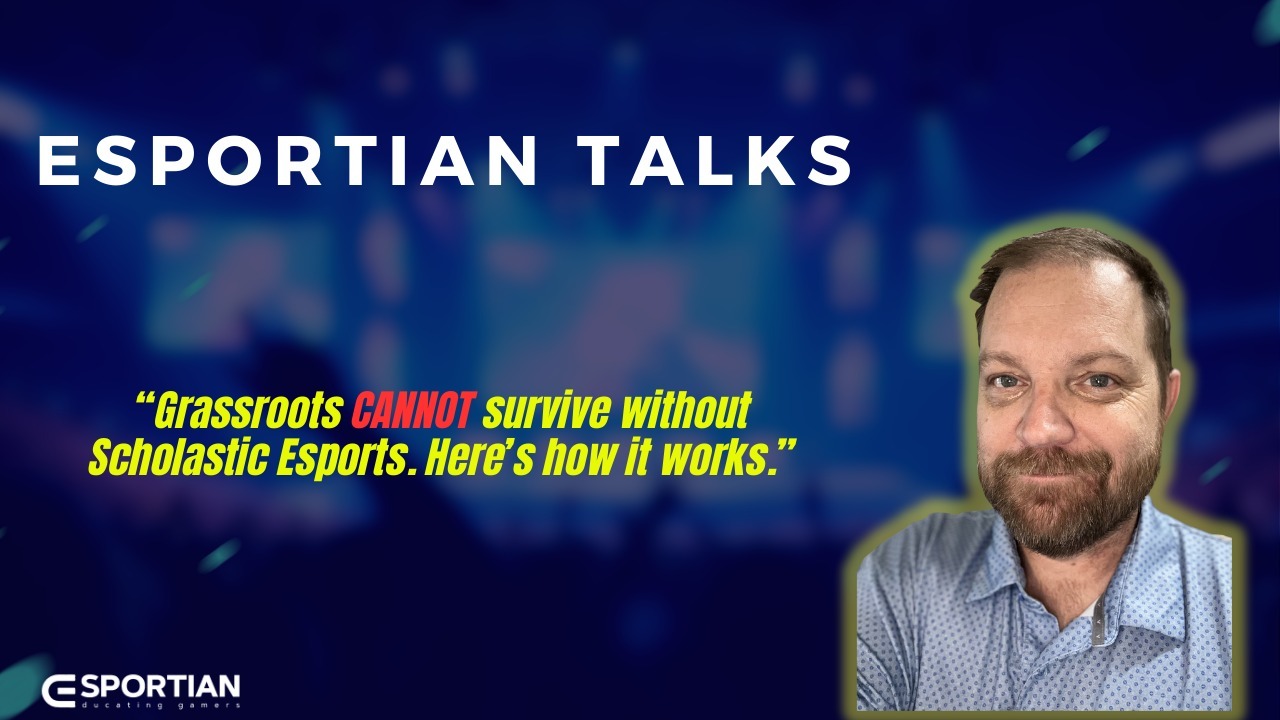
Educational institutions across North America are moving quickly to adopt esports, yet many initiatives stall because decision-makers treat esports as an extracurricular “gaming add-on” rather than a structured student-development ecosystem. In a recent interview, John Green , Principal Consultant at The SpeakEasy Group and the 2023 National Association of Collegiate Esports (NACE) Collegiate Advocate of the Year, outlined what sustainable adoption actually requires: alignment with institutional goals, intentional program design, and a coaching model that prioritizes student growth as much as competitive outcomes.
John entered esports through performance development in Overwatch, initially building warm-up routines for high-level players and learning through direct exposure to elite competitive environments how marginal gains are created systematically. That work evolved into coaching roles at the collegiate level, including the University of Missouri-Columbia , and later into broader advocacy and consulting work with schools and organizations. Today, through the Youth Gaming Association and projects such as AGI Sandbox, he focuses on enabling educators, especially those without deep gaming expertise to run esports programs that are pedagogically sound,feasible to administrators and parents.
What schools commonly misunderstand at launch
Schools often associate “students playing video games” with “esports,” which leads to programs that have equipment and enthusiasm but lack structure. In his framing, recreational gaming is not inherently esports; esports begins when competition is intentionally designed, expectations are shared, and practice is organized around measurable improvement. Without that foundation, teams tend to drift toward unproductive routines, inconsistent participation, and fragile rosters that cannot sustain an entire season.
This distinction matters because it changes how institutions evaluate success. If esports is treated as entertainment, the primary metric becomes winning. If esports is treated as student development, the metrics broaden to include participation stability, retention, academic progress, leadership, and the acquisition of transferable skills. He also argues that schools should not measure esports differently than other school activities: a sports team that does not win a championship can still deliver substantial developmental value if the environment is structured, supervised, and purposeful.
Sustainability begins with roster design, not hardware
While many institutions start with facility and equipment decisions, John emphasized that program sustainability is more often determined by roster durability and team culture. He illustrated this through the logic of tryouts. In a scholastic setting, the “best” individual players do not necessarily produce the best team outcomes. A team built exclusively around skill rankings may collapse mid-season if commitment, communication, and coachability are weak. Conversely, a slightly lower-skilled roster with high reliability, positive communication, and developmental mindset is more likely to improve over time and complete the season with cohesion.
To put this thought into action, John described a rubric-based approach to selection, an educator-friendly method that evaluates students across multiple dimensions such as communication quality, coachability, game understanding, and team-fit indicators. Importantly, this approach also protects programs from the most common mid-season failure mode: attrition that leaves committed students stranded when teammates disengage. In his view, the purpose of tryouts in schools is not simply to identify talent; it is to assemble a roster that can endure the season and develop together.
Esports as a platform for academic outcomes and career readiness
Green’s argument for esports in education is not anchored in the improbable outcome of producing professional players. Instead, he frames esports as a “high-frequency decision environment,” where students repeatedly process information, communicate under pressure, and adapt to rapidly changing conditions. When properly structured, these environments become reliable training grounds for skills that schools consistently claim to value: accountability, resilience, teamwork, leadership, and self-regulation.
A central mechanism is purpose. He noted that many educators are placed into esports leadership roles without being players themselves, often teachers who care deeply about students but lack game-specific expertise. His model does not require educators to teach advanced mechanics. It requires them to guide intentional practice themes (resource management in Rocket League, composition discipline in team-based titles, communication protocols during high-pressure rounds) and then hold students accountable to reflection and improvement. The educator supplies structure; the students supply game knowledge and iteration. Over time, students begin to connect effort to outcomes, which increases intrinsic motivation and reduces “random improvement” patterns that are difficult to sustain.
From an academic perspective, this logic can support stronger engagement and persistence. Students who care about competing are often willing to adopt better habits like time management, preparation, sleep routines, completion of school responsibilities because those habits directly influence performance.Students internalize discipline because performance provides immediate feedback when they do not.
Governance, advocacy, and educator leadership in collegiate esports
John does not assume esports will mature simply through growth; he assumes it matures through educator leadership that establishes norms, protects students, and creates repeatable program infrastructure. For collegiate esports, this is particularly relevant because leadership turnover, unclear operational standards, and inconsistent coaching approaches can degrade program continuity even when budgets are healthy.
In this context, advocacy is not marketing. Advocacy is the work of translating esports into institutional language: student retention, learning outcomes, community engagement, and measurable development. Schools that adopt esports responsibly tend to have leaders who can articulate why the program exists beyond competition, how student support is embedded into it, and what long-term outcomes justify the investment.
Perhaps the most actionable element of the interview was Green’s discussion of a new tool being developed for high school and collegiate coaches. The premise is simple: many coaches are volunteers, time-constrained, and expected to run a season without a clear practice curriculum. His tool addresses this by mapping an entire season into structured practice plans: what to focus on each week, how to design practice activities, and how to facilitate reflection so students connect practice objectives to match outcomes.
The strategic insight is that coaching in esports should prioritize reactions and habits rather than overloading students with instructions that slow decision-making. By organizing practice around fundamentals and letting students test and adapt within controlled objectives, coaches promote learning that becomes automatic under pressure. This resembles effective coaching in traditional sport: practice is structured; game day is execution.
Toward a responsible adoption model
His core message is that esports is not a shortcut to relevance for institutions, nor is it a risky distraction when properly implemented. It is a powerful but context-dependent tool. Schools that succeed treat esports as an educational intervention with competitive elements, not the other way around. They build rosters for durability, embed purpose into practice, align the program with student-development objectives, and support educators with systems that make coaching feasible.
If esports is to become, as he predicts, what traditional sport was for a prior generation, an organizing structure for community, identity, and youth development, then institutions must adopt it with the same seriousness they apply to other formative activities. The difference is not whether students are competing with a ball or a controller. The difference is whether the program is designed to develop them.
John entered esports through performance development in Overwatch, initially building warm-up routines for high-level players and learning through direct exposure to elite competitive environments how marginal gains are created systematically. That work evolved into coaching roles at the collegiate level, including the University of Missouri-Columbia , and later into broader advocacy and consulting work with schools and organizations. Today, through the Youth Gaming Association and projects such as AGI Sandbox, he focuses on enabling educators, especially those without deep gaming expertise to run esports programs that are pedagogically sound,feasible to administrators and parents.
What schools commonly misunderstand at launch
Schools often associate “students playing video games” with “esports,” which leads to programs that have equipment and enthusiasm but lack structure. In his framing, recreational gaming is not inherently esports; esports begins when competition is intentionally designed, expectations are shared, and practice is organized around measurable improvement. Without that foundation, teams tend to drift toward unproductive routines, inconsistent participation, and fragile rosters that cannot sustain an entire season.
This distinction matters because it changes how institutions evaluate success. If esports is treated as entertainment, the primary metric becomes winning. If esports is treated as student development, the metrics broaden to include participation stability, retention, academic progress, leadership, and the acquisition of transferable skills. He also argues that schools should not measure esports differently than other school activities: a sports team that does not win a championship can still deliver substantial developmental value if the environment is structured, supervised, and purposeful.
Sustainability begins with roster design, not hardware
While many institutions start with facility and equipment decisions, John emphasized that program sustainability is more often determined by roster durability and team culture. He illustrated this through the logic of tryouts. In a scholastic setting, the “best” individual players do not necessarily produce the best team outcomes. A team built exclusively around skill rankings may collapse mid-season if commitment, communication, and coachability are weak. Conversely, a slightly lower-skilled roster with high reliability, positive communication, and developmental mindset is more likely to improve over time and complete the season with cohesion.
To put this thought into action, John described a rubric-based approach to selection, an educator-friendly method that evaluates students across multiple dimensions such as communication quality, coachability, game understanding, and team-fit indicators. Importantly, this approach also protects programs from the most common mid-season failure mode: attrition that leaves committed students stranded when teammates disengage. In his view, the purpose of tryouts in schools is not simply to identify talent; it is to assemble a roster that can endure the season and develop together.
Esports as a platform for academic outcomes and career readiness
Green’s argument for esports in education is not anchored in the improbable outcome of producing professional players. Instead, he frames esports as a “high-frequency decision environment,” where students repeatedly process information, communicate under pressure, and adapt to rapidly changing conditions. When properly structured, these environments become reliable training grounds for skills that schools consistently claim to value: accountability, resilience, teamwork, leadership, and self-regulation.
A central mechanism is purpose. He noted that many educators are placed into esports leadership roles without being players themselves, often teachers who care deeply about students but lack game-specific expertise. His model does not require educators to teach advanced mechanics. It requires them to guide intentional practice themes (resource management in Rocket League, composition discipline in team-based titles, communication protocols during high-pressure rounds) and then hold students accountable to reflection and improvement. The educator supplies structure; the students supply game knowledge and iteration. Over time, students begin to connect effort to outcomes, which increases intrinsic motivation and reduces “random improvement” patterns that are difficult to sustain.
From an academic perspective, this logic can support stronger engagement and persistence. Students who care about competing are often willing to adopt better habits like time management, preparation, sleep routines, completion of school responsibilities because those habits directly influence performance.Students internalize discipline because performance provides immediate feedback when they do not.
Governance, advocacy, and educator leadership in collegiate esports
John does not assume esports will mature simply through growth; he assumes it matures through educator leadership that establishes norms, protects students, and creates repeatable program infrastructure. For collegiate esports, this is particularly relevant because leadership turnover, unclear operational standards, and inconsistent coaching approaches can degrade program continuity even when budgets are healthy.
In this context, advocacy is not marketing. Advocacy is the work of translating esports into institutional language: student retention, learning outcomes, community engagement, and measurable development. Schools that adopt esports responsibly tend to have leaders who can articulate why the program exists beyond competition, how student support is embedded into it, and what long-term outcomes justify the investment.
Perhaps the most actionable element of the interview was Green’s discussion of a new tool being developed for high school and collegiate coaches. The premise is simple: many coaches are volunteers, time-constrained, and expected to run a season without a clear practice curriculum. His tool addresses this by mapping an entire season into structured practice plans: what to focus on each week, how to design practice activities, and how to facilitate reflection so students connect practice objectives to match outcomes.
The strategic insight is that coaching in esports should prioritize reactions and habits rather than overloading students with instructions that slow decision-making. By organizing practice around fundamentals and letting students test and adapt within controlled objectives, coaches promote learning that becomes automatic under pressure. This resembles effective coaching in traditional sport: practice is structured; game day is execution.
Toward a responsible adoption model
His core message is that esports is not a shortcut to relevance for institutions, nor is it a risky distraction when properly implemented. It is a powerful but context-dependent tool. Schools that succeed treat esports as an educational intervention with competitive elements, not the other way around. They build rosters for durability, embed purpose into practice, align the program with student-development objectives, and support educators with systems that make coaching feasible.
If esports is to become, as he predicts, what traditional sport was for a prior generation, an organizing structure for community, identity, and youth development, then institutions must adopt it with the same seriousness they apply to other formative activities. The difference is not whether students are competing with a ball or a controller. The difference is whether the program is designed to develop them.
